
UJS Best Practice Guidance for institutions to support Jewish students and tackle antisemitism
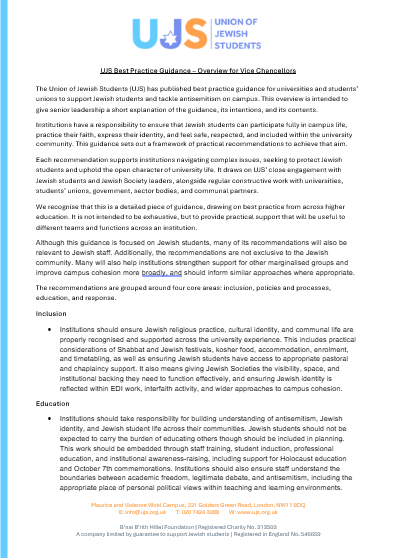
Institutions have a responsibility to ensure that Jewish students can participate fully in campus life, practice their faith, express their identity, and feel safe, respected, and included within the university community. This guidance sets out a framework of practical recommendations to achieve that aim.
Each recommendation supports institutions navigating complex issues, seeking to protect Jewish students and uphold the open character of university life. It draws on UJS’ close engagement with Jewish students and Jewish Society leaders, alongside regular constructive work with universities, students’ unions, government, sector bodies, and communal partners.
| The guidance can be found here | An overview for Vice Chancellors can be found here |
|
|
 |

The guidance follows Time for Change, UJS’ landmark report on campus antisemitism. The report can be found here.
The detailed guidance draws on best practice from across the sector. It is not intended to be exhaustive, but to provide practical support that will be useful to different teams and functions across an institution.
Many institutions have already shown real leadership in response to the serious challenges they have faced since October 7th 2023. Whilst this guidance highlights many examples of best practice from around the country, there are even more examples it cannot include.
We hope this guidance provides reassurance, practical support, and a basis for continued partnership. UJS looks forward to working with institutions to help ensure Jewish students are safe, included, and able to thrive on campus.
What can I do?
A Jewish student
- You can send this guidance to your university and students’ union and ask them to adopt the recommendations. You can ask them to meet with your JSoc, UJS and the Jewish chaplains to discuss the recommendations and their implementation.
A Vice Chancellor
- You can make sure your institution adopts the recommendations within this guidance. You can make sure the guidance is seen by the right people in your institution, and you can lead regular checks on your institution’s progress on the recommendations. You can meet regularly with your JSoc, UJS and the Jewish chaplains to discuss the recommendations and their implementation. You can work with your students’ union to ensure that they adopt the recommendations and collaborate on work to support Jewish students, guided by these recommendations.
A member of university staff
- You can make sure the guidance is seen by the right people in your institution and ask them to lead on the adoption of the recommendations. If you are responsible for an area that covers a recommendation in the guidance, you can lead on the adoption of the recommendations and communicate this back to your JSoc, UJS and the Jewish chaplains, as well as to your institution’s senior leadership.
A Students’ Union
- You can make sure that your union adopts the recommendations within this guidance. You can make sure the guidance is seen by the right people within your union, and you can meet regularly with your JSoc, UJS and the Jewish chaplains to discuss the recommendations and their implementation. You can work with your university to ensure that they adopt the recommendations and collaborate on work to support Jewish students, guided by these recommendations.
A further education institution
- Whilst the guidance is targeted towards the higher education sector, many of the recommendations are relevant for the further education sector. You can evaluate the recommendations that are reasonably achievable in your institution and make sure the right people in your institution see the guidance and lead on the adoption of the recommendations.
Louis Danker, UJS President 2025/26 said:
- "As universities navigate the complex challenge of combatting normalised antisemitism, UJS has a crucial role in supporting them to best serve their Jewish students. We've compiled a comprehensive set of best practice, based on engagement across the higher education sector, to ensure Jewish students' belonging and prosperity on campus is protected and enhanced. We are excited to work with university and students’ union leaders to ensure they implement our recommendations across their institutions."
Bridget Phillipson, Education Secretary said:
- "Antisemitism has no place in our communities and no place on our campuses. We owe it to Jewish students to ensure they feel safe, supported and that they truly belong in our universities. I welcome this guidance as a powerful tool for universities in tackling antisemitism, setting out practical steps to help create a genuinely inclusive environment and support Jewish students. This is alongside government investment of £7 million into tackling antisemitism in education, as part of our commitment to promoting social cohesion and stamping out hatred."
Vivienne Stern MBE, Universities UK CEO said:
-
"Antisemitism is a growing threat to our society and we must all act together to counter it. Universities are uniquely well placed to play a positive role - not only by acting to ensure Jewish students and staff are welcome, safe and supported on our campuses, but also by educating campus communities to recognise racial and religious harassment, and to understand where the boundaries between legitimate protest and antisemitism lie. We will continue to work with those in the sector and beyond to make a difference."
This guidance would not have been possible without the valued support and contributions of:
- Advance HE, the Antisemitism Policy Trust, the Board of Deputies, the Community Security Trust, Conservatoires UK, the Department for Education, Holocaust Education Trust, the Jewish Leadership Council, Medr, the Office for Students, Progressive Jewish Students, the Student Jewish Medical Association, Universities Scotland, Universities UK, and University Jewish Chaplaincy.
We extend particular gratitude to:
- Lord Mann, His Majesty’s Government’s Independent Advisor on Antisemitism, for his advice and contribution to this guidance.
- Our donors and partners, who enable the work we do.
- Our Jewish student leaders, who have fought tirelessly to protect and empower their communities.
- The whole Union of Jewish Students team, for their endless work to fight for proud Jewish life on campus.